On this page
- Overview
- The product constraint was anonymity itself
- Narrowing the concept into a first believable slice
- Making the valuation flow earn its friction
- Making anonymous browsing legible
- Designing trust into the chat progression
- Giving stakeholders something concrete to align around
- Future-state concepting
- Outcome
Case Study
Prodev / FIJI
Designing staged trust for a private broker marketplace
What this proves
I can help a startup collapse a broad, ambiguous product vision into a credible first system by defining the trust model, structuring the flows, and giving the team something concrete enough to review, present, and build against.
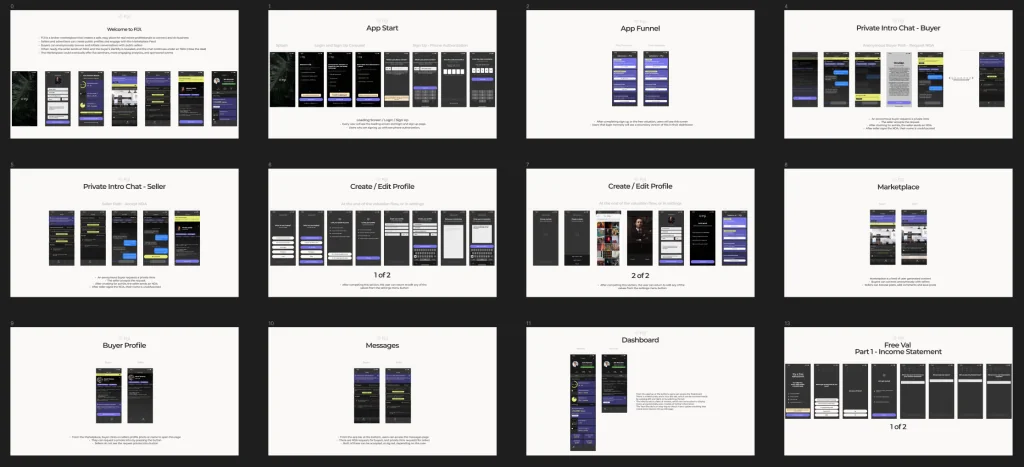
The product constraint was anonymity itself
FIJI was not a social app for brokers. It was a marketplace concept where sensitive early-stage deal conversations needed to feel safe. Brokers wanted to explore acquisition opportunities, signal interest, and move toward serious discussions without exposing too much too soon.
That requirement changed the entire interaction model. Anonymous and redacted profiles protected privacy, but they also made the marketplace harder to browse and evaluate. Users could not rely on the usual social or marketplace signals because too much of the profile was intentionally hidden. The design problem was to preserve anonymity long enough for trust to form without letting the product feel too vague or low-commitment to use.
Narrowing the concept into a first believable slice
The original vision was broader than what the first release could realistically support. The founders had ideas around marketplace browsing, social-style feeds, recommendation logic, paid content, live events, and advertising. That breadth was useful for ambition, but it was not useful for shipping.
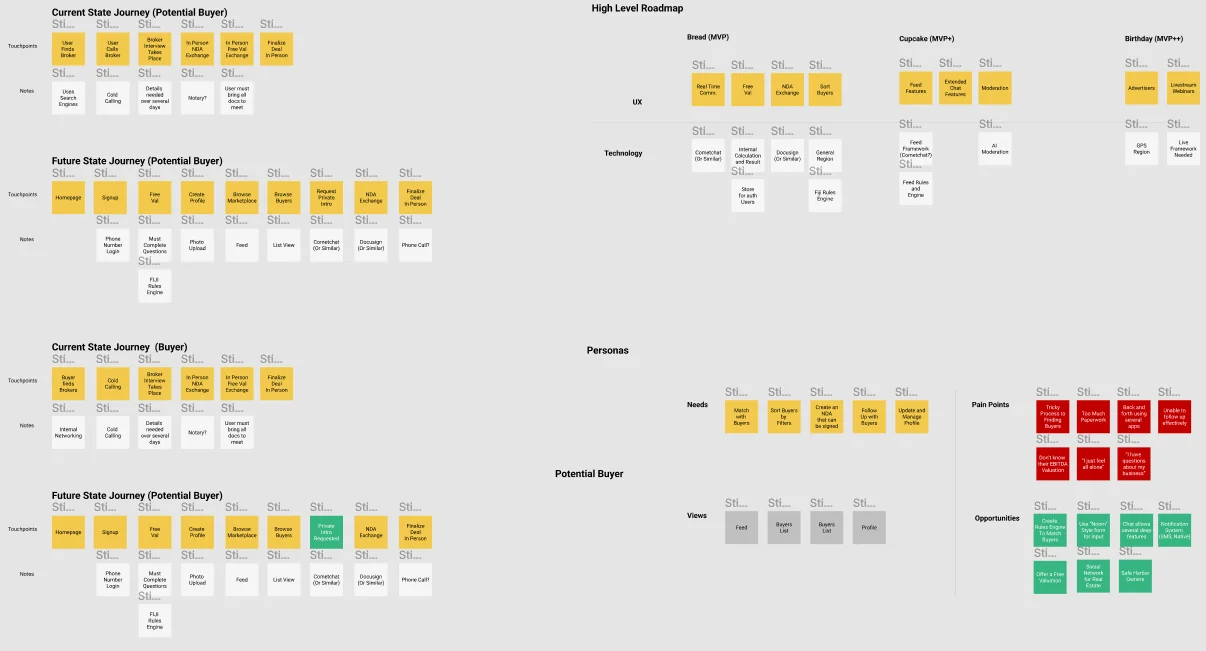
Working with the CEO and Product Owner, I helped define the product in stages across MVP, MVP+, and MVP++. The most useful early move was not polishing screens. It was separating core proof-of-concept needs from future marketplace ambitions. We mapped personas, current and future-state journeys, and release scope so design and engineering decisions had a clearer source of truth.
The MVP focused on three things that had to work together: a valuation-led entry point, a usable private-introduction model, and a structured path toward NDA exchange. Everything else was explicitly deferred.
Making the valuation flow earn its friction
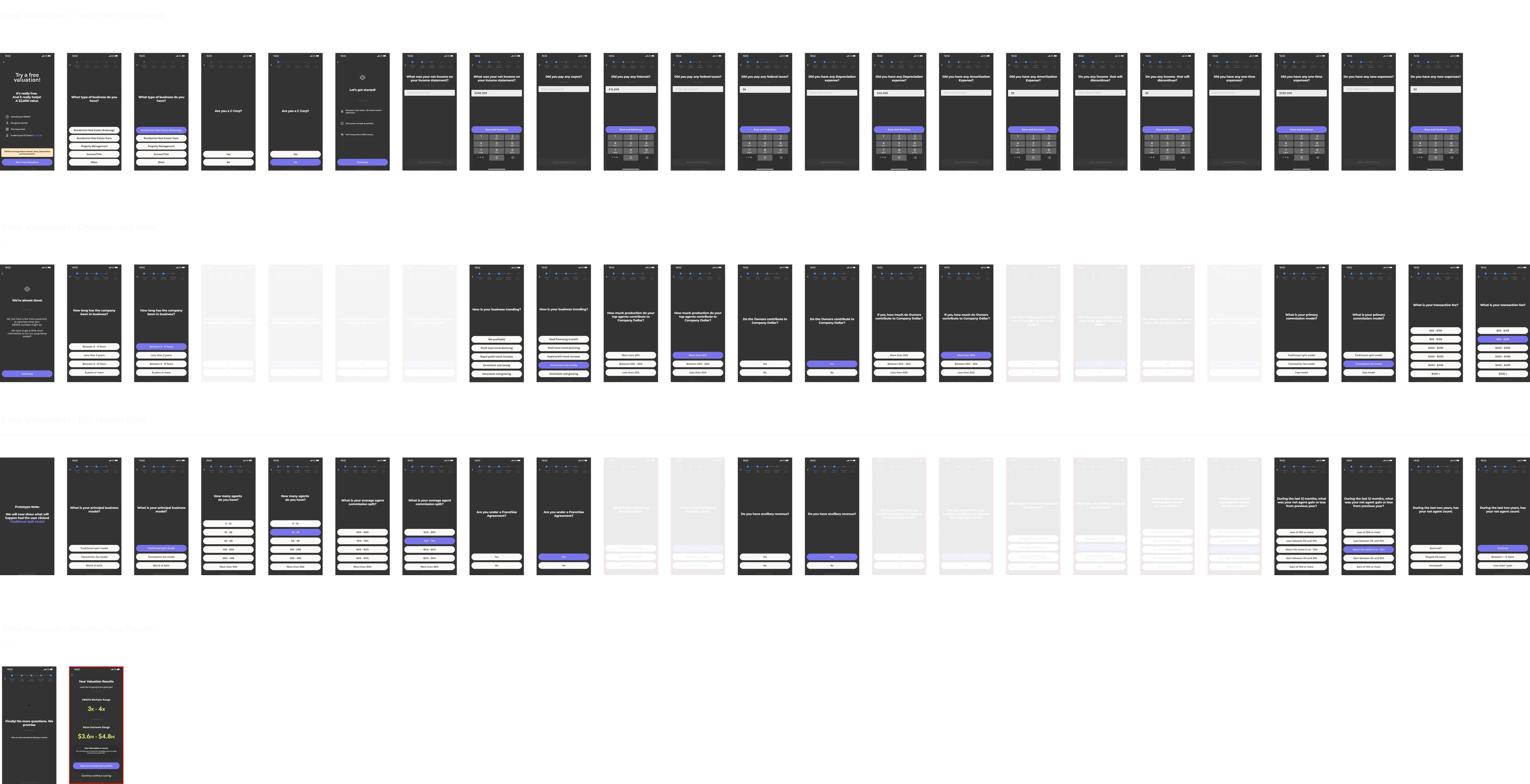
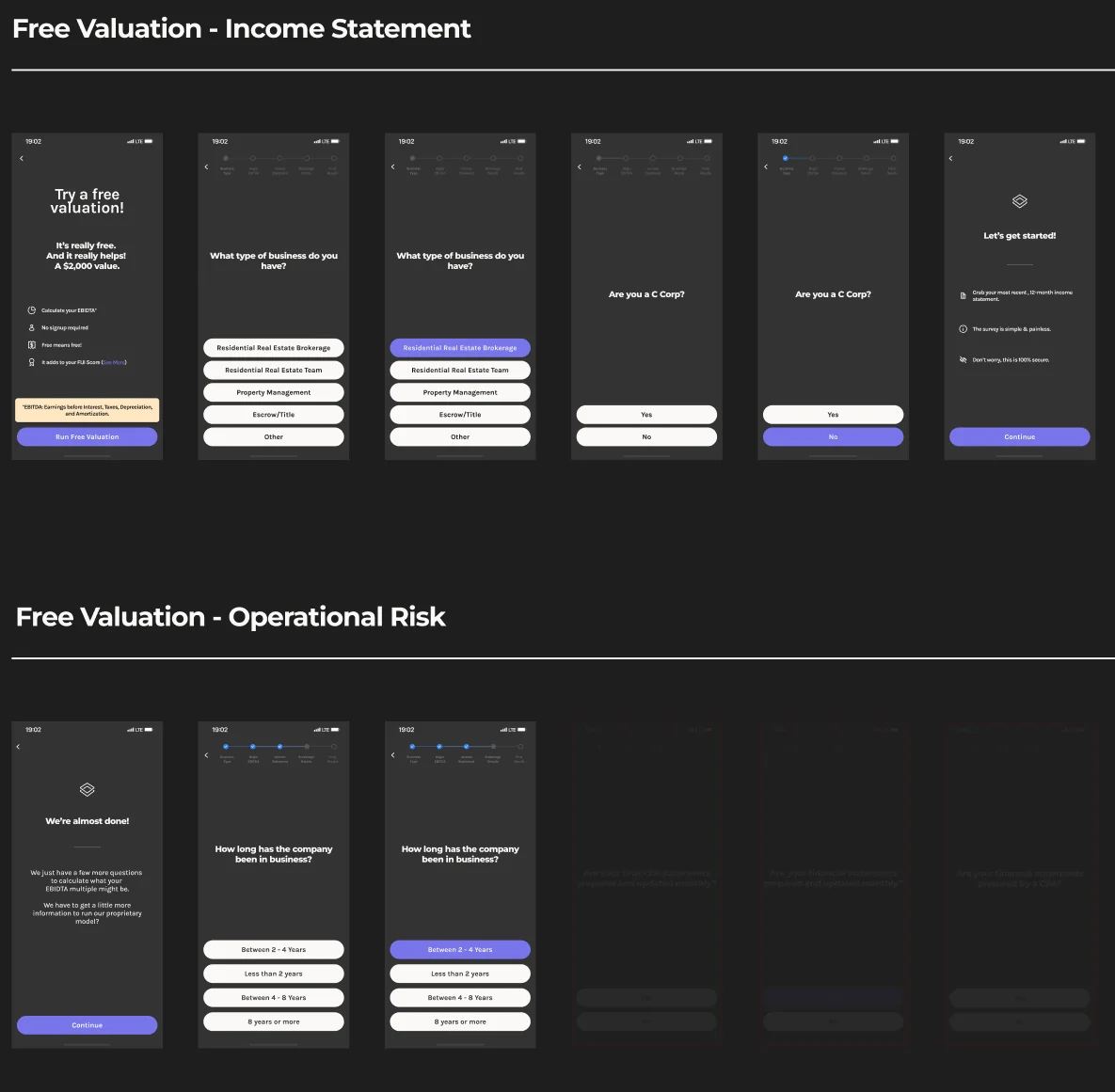
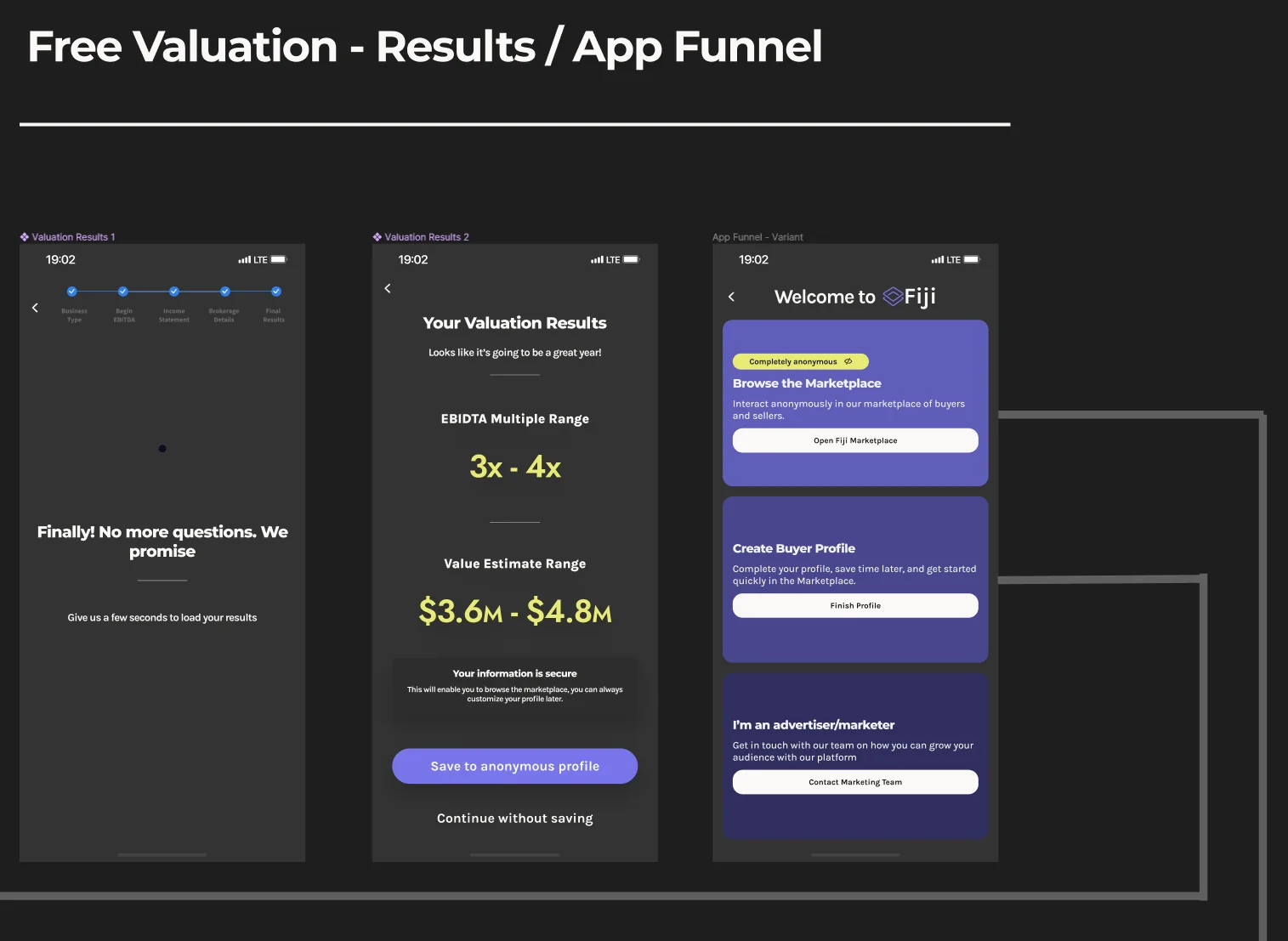
One of the product's strongest hooks was a free valuation survey. It needed to be useful on its own, giving brokers something immediately valuable. But it also had to generate structured inputs for matching and recommendation logic elsewhere in the app. That made it more than onboarding. It was the first value exchange between the user and the platform.
The tension was straightforward. Stakeholders wanted richer information to power better matching. But a long universal questionnaire would have added too much friction before the platform had earned enough trust to justify it. I broke the flow into categorized sections, used conditional logic so users only saw questions relevant to their earlier answers, and treated the experience as a guided progression rather than one static form.
Some paths skipped sections entirely. Users whose answers indicated they did not need the full EBITDA-related valuation path were routed past it. That kept the flow narrower, faster, and better aligned with the scoring model behind it, without sacrificing the structured data the product needed to make recommendations useful.
Making anonymous browsing legible
Anonymity helped the product feel safer, but it also removed many of the signals people normally use to judge whether a conversation is worth pursuing. If too much was hidden, browsing risked feeling arbitrary.
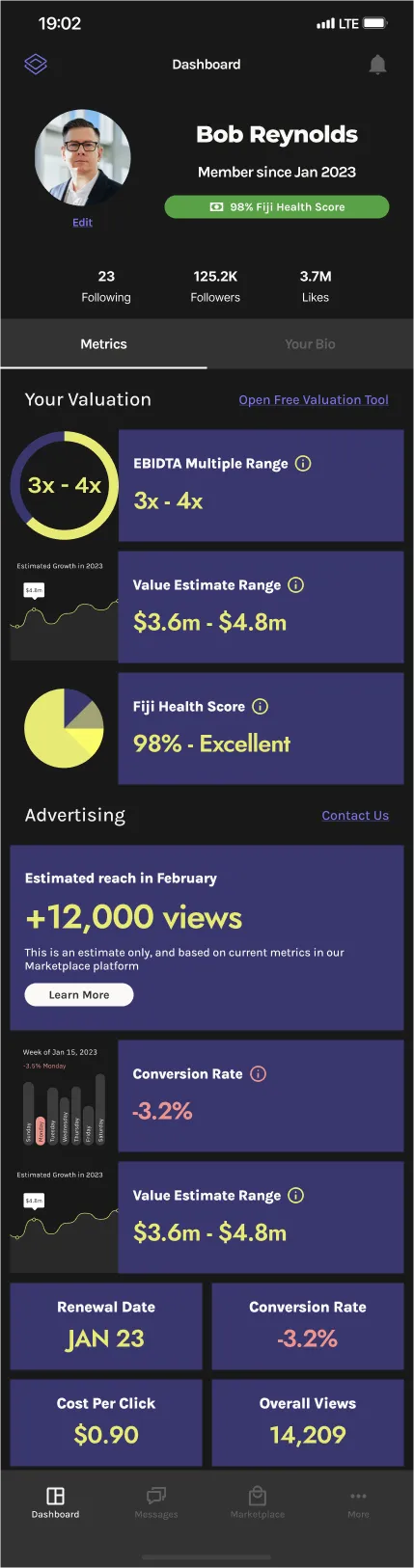
That led to a more deliberate marketplace model. Instead of relying on a social-feed assumption, the product moved closer to structured browsing with summary signals like the FIJI Health Score, employee count, and location. The goal was not to build Instagram for brokers. It was to make private opportunity discovery feel legible enough to act on, even when profiles were intentionally redacted.
Designing trust into the chat progression
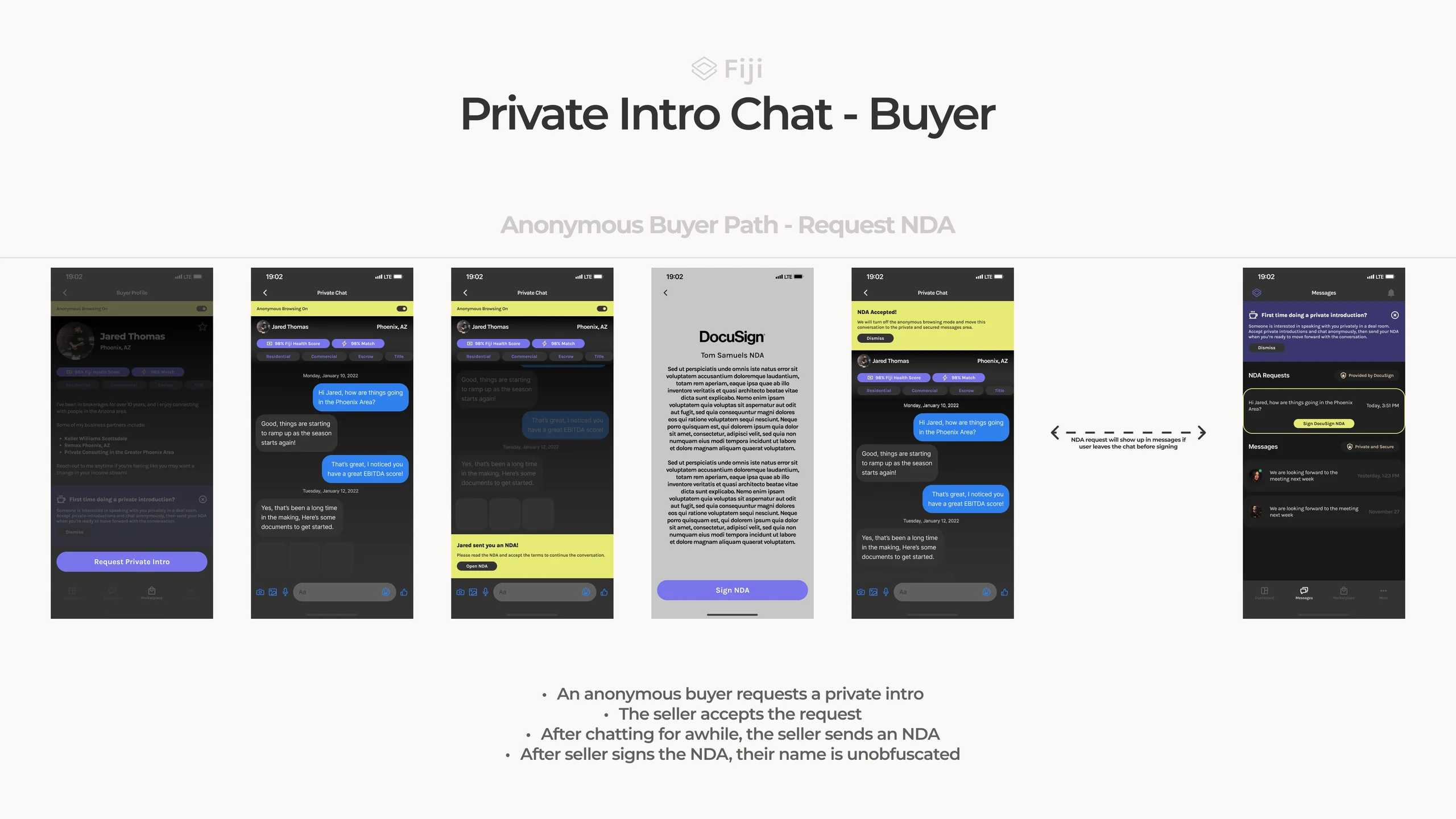
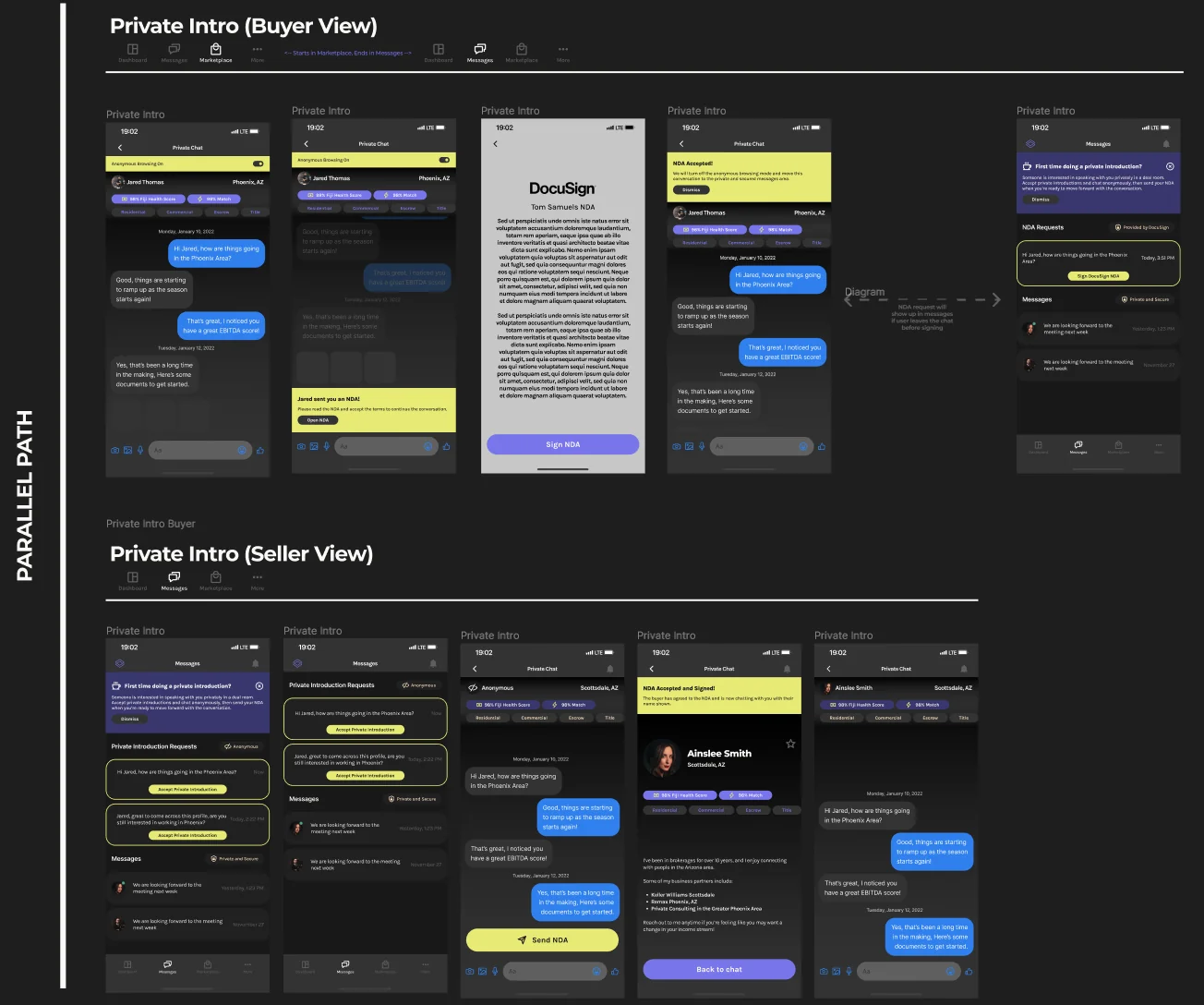
The chat model was the center of the product. Brokers needed to start anonymous, build confidence through conversation, and only then move into NDA exchange and deeper disclosure. That made the messaging flow a trust system, not just a communication feature.
I designed the progression from anonymous conversation to private introduction to NDA-based exchange, including the service states around when an NDA is introduced, how it is accepted, and how those conversations are visually separated from ordinary chats. NDA-ready conversations needed to feel materially different because the interface had to signal that the relationship, the stakes, and the next step had changed. These were not casual chats. They were the beginning of conversations that could lead to seven-figure deals.
This was also where the product's core tension became clearest. If the chat looked too casual, the trust model felt weak. If it looked too formal too early, the product lost the openness that made first contact possible. The design needed to hold both of those pressures without collapsing into either.
Working within CometChat's plugin constraints and using DocuSign for NDA execution kept the solution grounded in delivery reality. Rather than inventing a fully custom communication and signing stack, the product could rely on familiar infrastructure and use design to make the progression legible. For first-time use, I added dismissible tooltip-based onboarding so the product could explain why anonymous chat existed and how NDA progression worked without relying on a static tutorial.
Giving stakeholders something concrete to align around
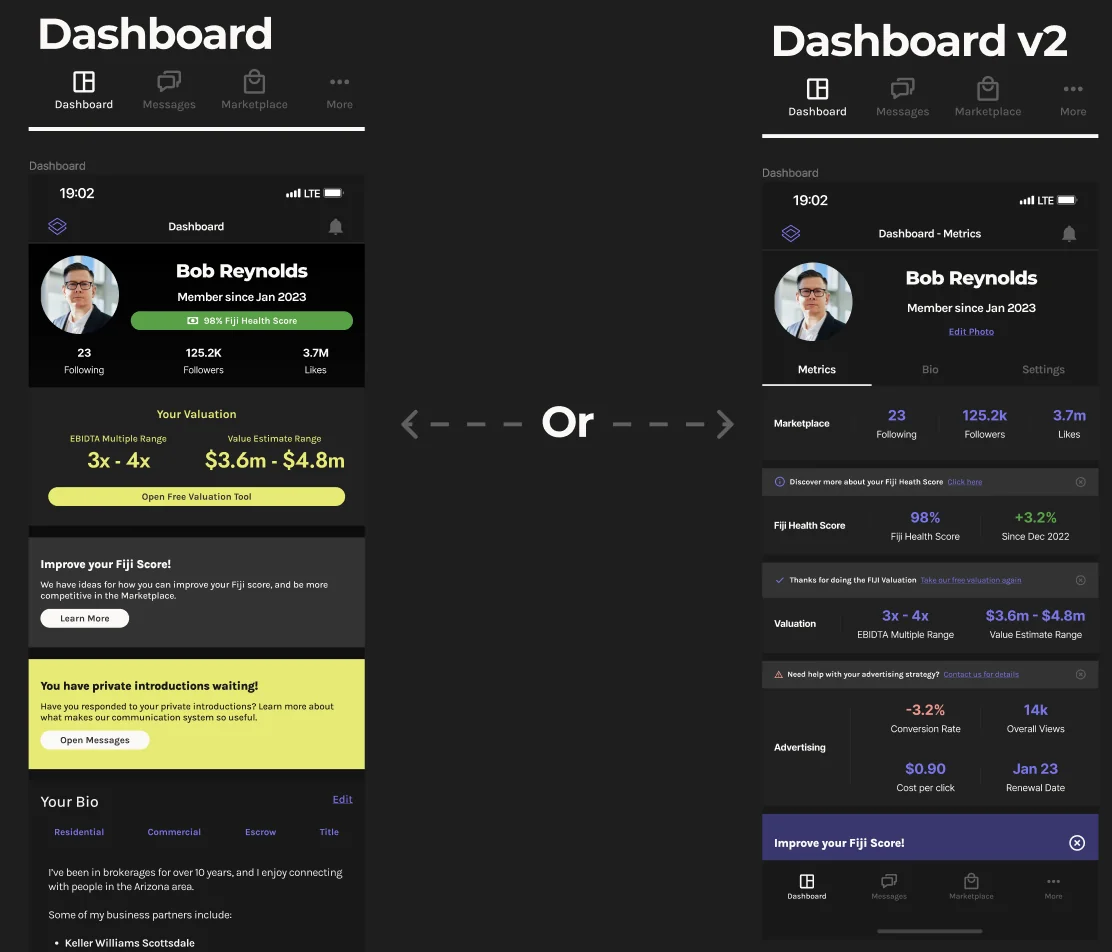
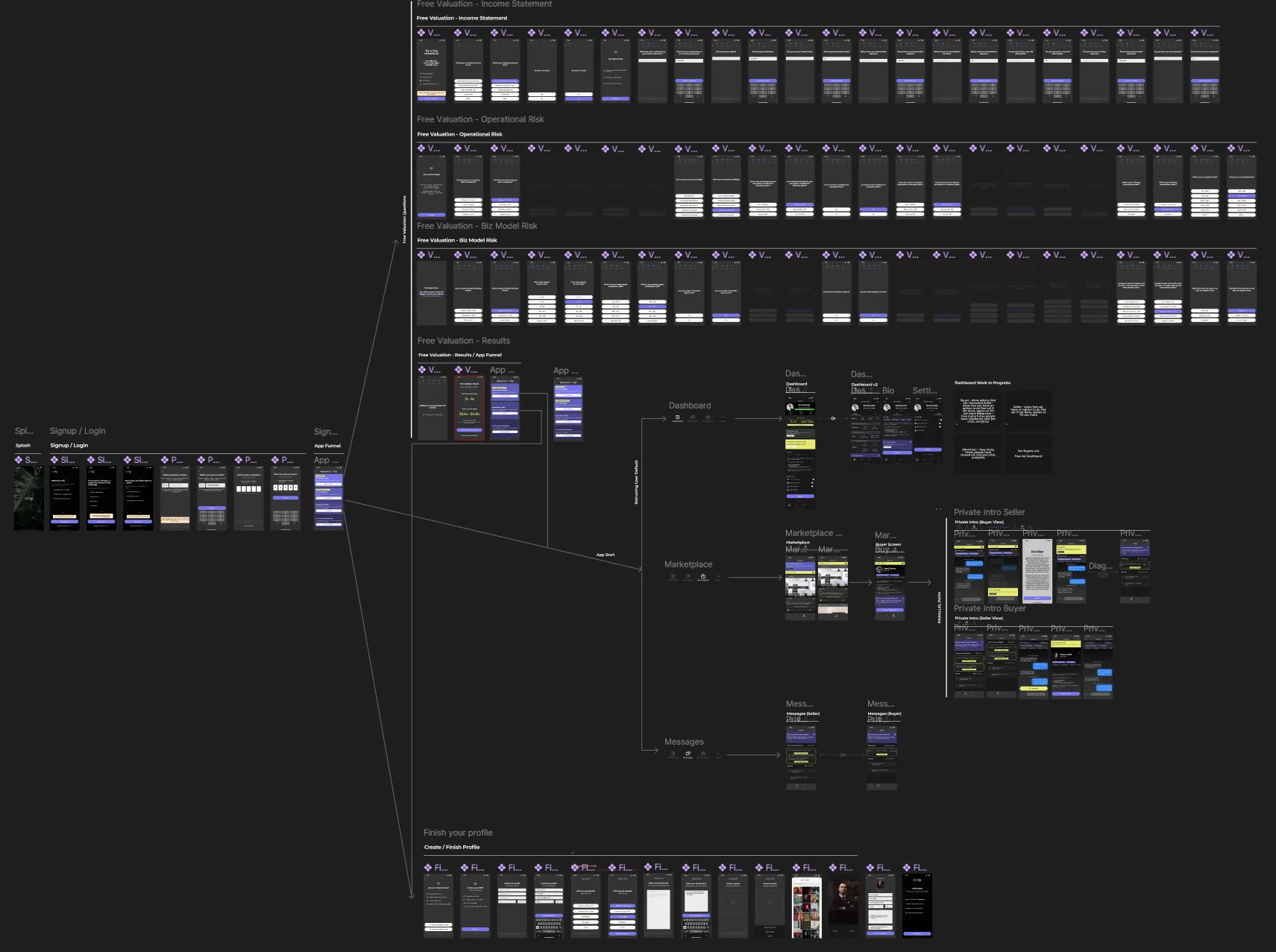
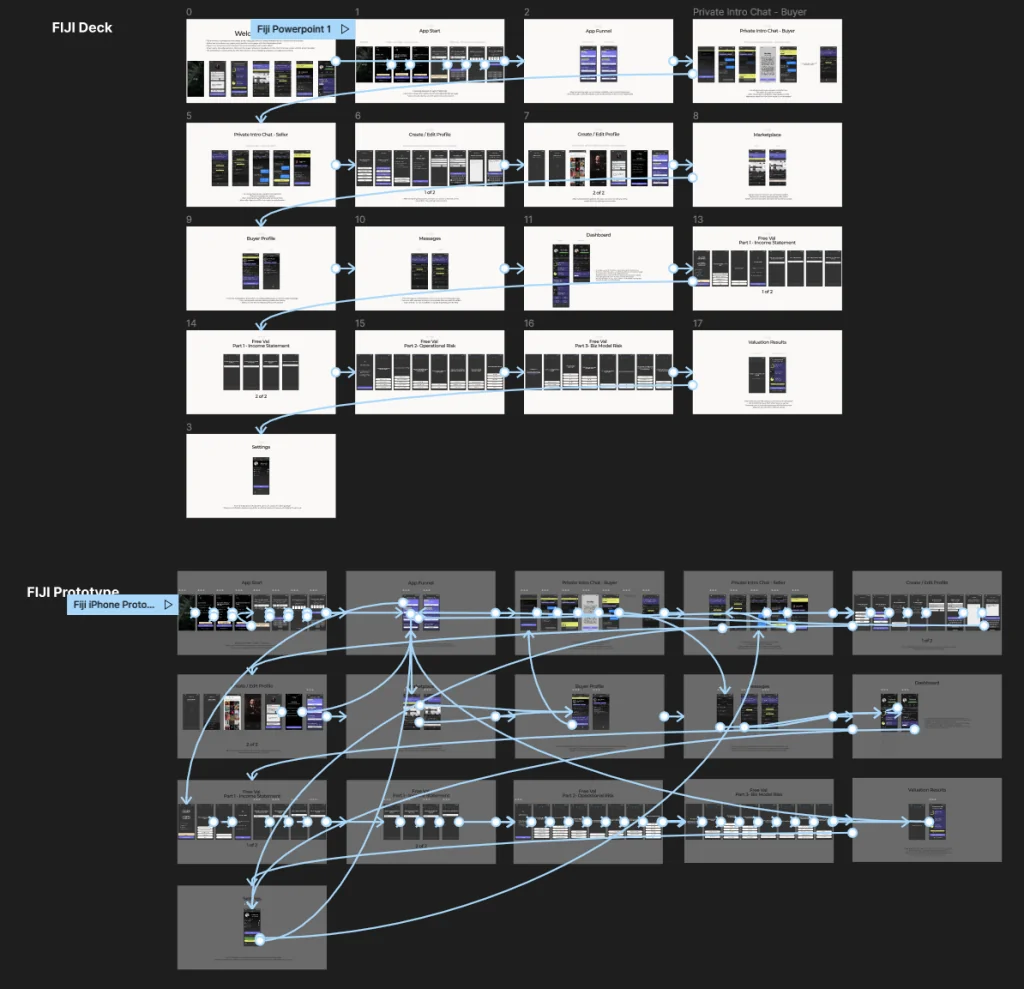
A large part of the work was making the product legible outside design. I broke major flows into printable decks, connected prototypes, and discrete review artifacts that could be reused in meetings, annotated live, and re-sequenced as priorities changed. That format helped the team stop treating the product as a vague collection of startup ideas and start treating it as a smaller set of concrete flows with clearer dependencies. The artifacts were also concrete enough for stakeholders to use in fundraising conversations.
Future-state concepting
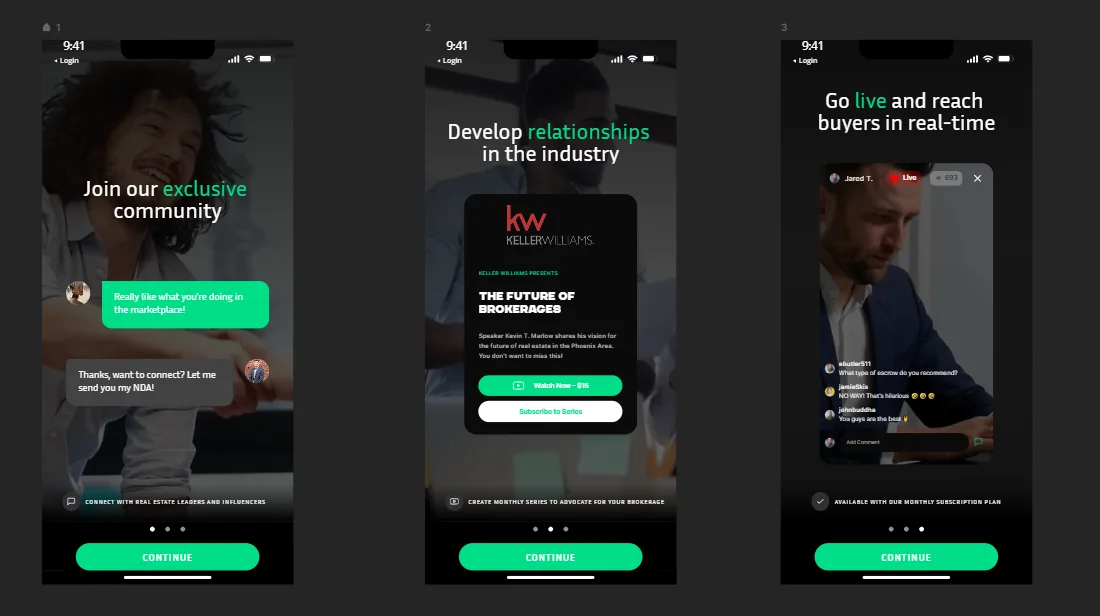
Beyond the first slice, I explored future-state concepts in Framer to help the team pressure-test broader engagement ideas like webinars, live sessions, and richer community behaviors. These were not part of the proof-of-concept MVP. They existed to help founders see where the product could go next and make better near-term scope decisions without confusing later-stage ambition with what the current release needed to prove.
Outcome
The most meaningful result of this work was not a fully realized marketplace. It was a clearer first product slice.
By the end of the engagement, the team had a concrete model for how valuation, private introductions, and NDA-based trust progression could work together as a connected product rather than a loose set of ideas. The flows were concrete enough to review, present, and continue building against. The trust model itself became far more legible to stakeholders.
The work left behind a practical operating base: staged release planning, reviewable flow decks, and implementation-aware prototypes that made it easier to align on what belonged in the proof of concept versus later releases. The team later brought me back to adapt the product into a desktop web app, extending the core trust model into a broader marketplace surface.
The strongest proof in this case is the interaction model itself: staged disclosure, valuation as a value exchange, and a private-introduction path that turned anonymity into a usable marketplace behavior rather than a vague startup promise.
Appendix
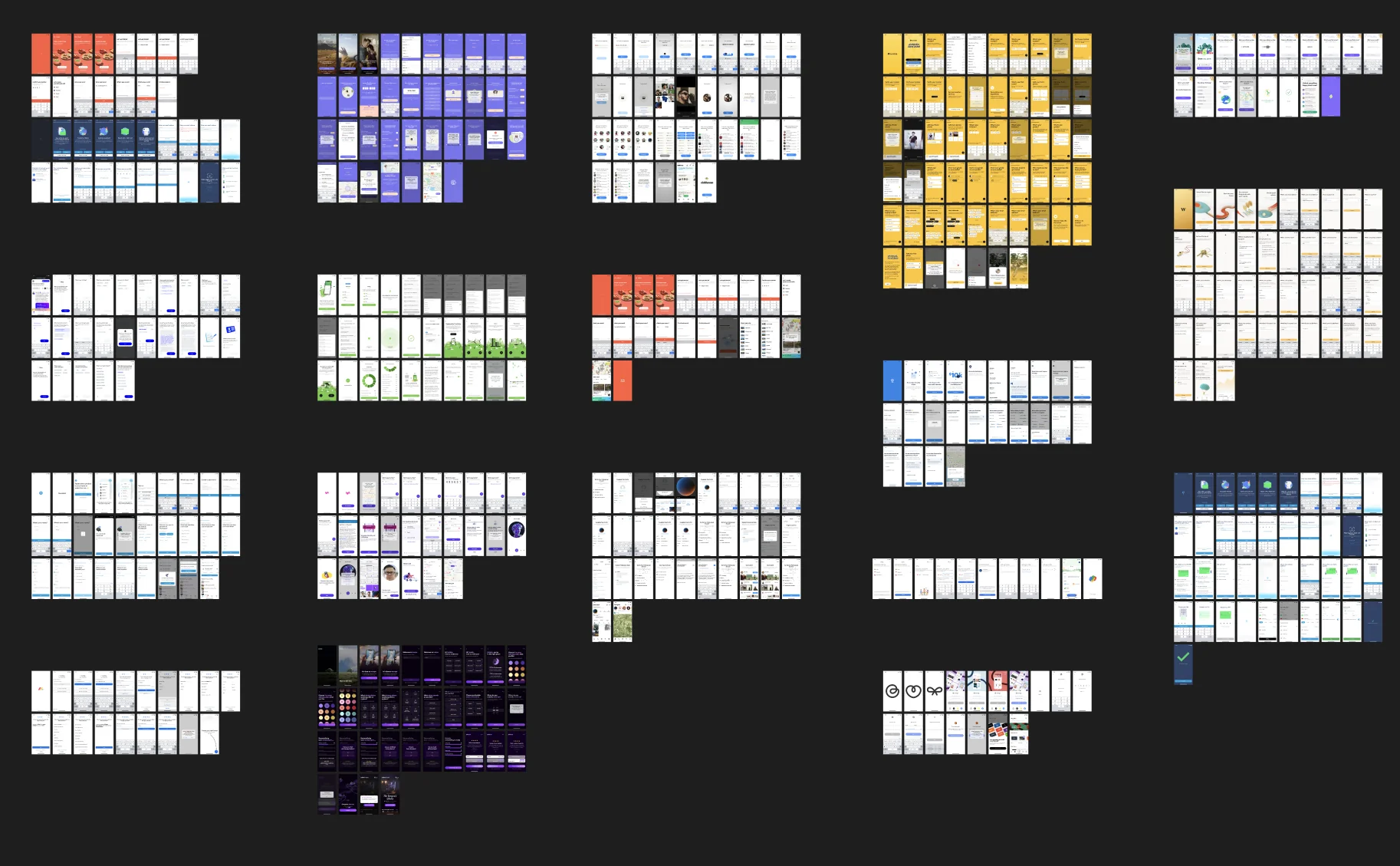
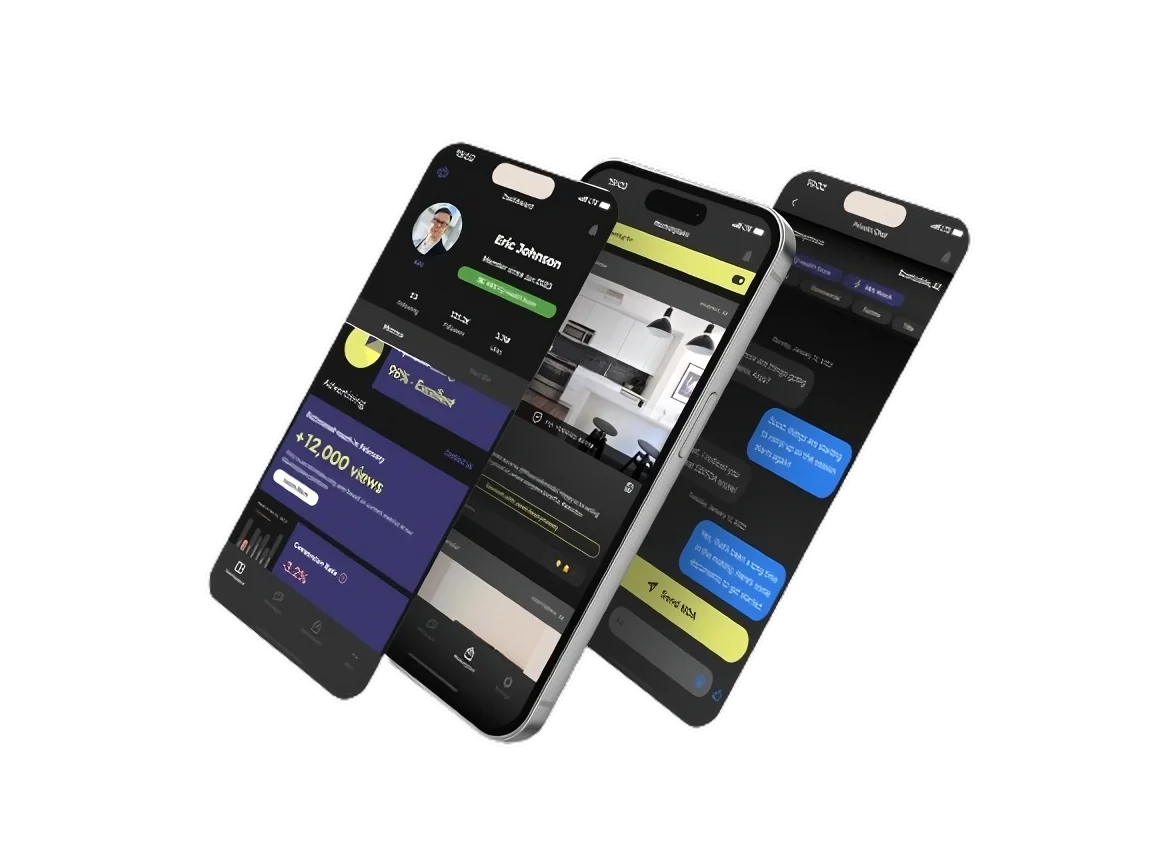
The artifacts below support deeper inspection. They are not part of the primary scroll because they work better as receipts than as core narrative beats.